From recent observations, a gentle audit:
Blue - simple, pretty and common.
Great - 'Fat Blue Tit, with black belly stripe', I think to myself.
Coal - my favourite - a demure wee thing.
And now, Marsh - as we approached Doxeys Marshes, I saw the fleeting wag of a tail and proclaimed, 'Long-tailed tit' - really loud and professional, like. But on closer, quieter inspection, The Boy put me right, 'It's a Marsh Tit... (whispers) punk ass fool'.
Sunday felt like Spring, and the beginning - proper - of 2010.
Wednesday, March 10, 2010


Saturday, March 06, 2010
three moments
Eleven days ago.
Ahead of the recent cremation of my grandmother, I'd had a falling out with my sister - nothing more than a brief flare-up, but this was unusual - Sister and I generally get on well. Leaving the north east, prior to my return for the cremation, we'd not healed the rift. Unsatisfactory, but something that we could both live with.
On my return for said cremation, about to enter the familial home's front room, I wondered what kind of atmosphere awaited. As I move into the open doorway, Sister spotted me, suppressed an embarrassed smile and raised an eyebrow at me - a quiet 'Hello'. In response, I stick two fingers up at her and ask, 'Cup of tea?'.
That's how we don't deal with issues.
After the cremation service and an entirely pleasant afternoon, spent with relatives who I'd not seen in years, I requested a lift to the station from Sister, and she obliged. En route - a 15 minute hop, we discussed our mother, and strategies for helping mum - mam - to move on from our grandmother's death. Broadly speaking, we were as one. On reaching Durham, I stepped out of the car, took my bags and said thanks for the lift. Sister replies, 'Y' alright'. And then, as I have my hand on the door - about to shut it, she calls out, 'Oi! Git!' 'What?' I ask, leaning back in. 'Thanks for doing that today', she said, to which I nodded. 'See y' next month', and closed the door.
That's how we draw lines under issues.
Ahead of the recent cremation of my grandmother, I'd had a falling out with my sister - nothing more than a brief flare-up, but this was unusual - Sister and I generally get on well. Leaving the north east, prior to my return for the cremation, we'd not healed the rift. Unsatisfactory, but something that we could both live with.
On my return for said cremation, about to enter the familial home's front room, I wondered what kind of atmosphere awaited. As I move into the open doorway, Sister spotted me, suppressed an embarrassed smile and raised an eyebrow at me - a quiet 'Hello'. In response, I stick two fingers up at her and ask, 'Cup of tea?'.
That's how we don't deal with issues.
After the cremation service and an entirely pleasant afternoon, spent with relatives who I'd not seen in years, I requested a lift to the station from Sister, and she obliged. En route - a 15 minute hop, we discussed our mother, and strategies for helping mum - mam - to move on from our grandmother's death. Broadly speaking, we were as one. On reaching Durham, I stepped out of the car, took my bags and said thanks for the lift. Sister replies, 'Y' alright'. And then, as I have my hand on the door - about to shut it, she calls out, 'Oi! Git!' 'What?' I ask, leaning back in. 'Thanks for doing that today', she said, to which I nodded. 'See y' next month', and closed the door.
That's how we draw lines under issues.
Thursday, March 04, 2010
two dramas
Walking into the Riverside Studios, Hammersmith, last Friday, I was reminded of the Green Room, Manchester - large glass frontage, confident contemporary air to the space, and just a hint of middle-browness.
I was there with The Professor, to see a Love and Madness production of Sam Shepard's Fool for Love.
Reviews had been mixed, and the particular hook for drawing me in was the knowledge that this was Carl Barat's first professional acting gig. Walking into the theatre space, we enter at stage level, with the cast already in position - Barat (as Eddie) sits, head bowed. On a nearby bed, Sadie Frost (as May) is curled up. Gerard McDermott (as the Old Man) is half-way up a staircase, amongst the one-tier bank of seats. A small amount of additional seating is at stage level. The capacity looks to be around 300. As the play begins, I count 23 of us and immediately make the mental note to not spend the next hour or so (it's a short play) doing arithmetic and getting distracted by the economics of such a production.
 (Photo: Luke Varley)
Soon, we are immersed in the messy, alcohol-fuelled relationship of Eddie and May. There is an undertow of violent potential - with drawled cat calls and deep southern swagger the order of the pair's clashing over Eddie's time away. The motel room environment is claustrophic.
 (Photo: Luke Varley)
About twenty minutes into the play, I think to myself, 'It's not entirely obvious where this is going'. By now, we've had the addition of the Old Man's third-party perspective, narrating against the main protagonists' conflict. The Old Man is drunk, and has a different kind of energy to the younger actors. The professor will later comment, that 'He held the whole thing together'. Looking at the text of the play, it would be easy to take the same view. Thus far, each of the three characters have presented the further challenge for the actors of 'doing drunk', or 'doing drinking', but they're getting by.
 (Photo: Luke Varley)
Whether by design, or fluke, McDermott's Old Man makes good use of the light in the space - stepping into and out of the shadows, and at one time, resting amongst the audience.
 (Photo: Luke Varley)
As the play moves on to further disrupt the Eddie-May dialogue, with Neil Sheppeck's Martin - a humble man with a romantic interest in May - entering the fray, we build to revelations surrounding the identity of the Old Man, and the conequences of this for the doomed duo. Martin, meanwhile, is a character that hardly develops - aside from deciding that he wants to get out of there.
 (Photo: Luke Varley)
In all, the production was competent - unremarkable, but certainly not bad. My guessing is that some of those mixed reviews would have warded off a good degree of shot-in-the-dark footfall, and so our two dozen get to do theatre intime. Through the course of the production, I wondered at the processes that may - or may not - have been undertaken, by way of casting. I wondered about the extent to which voice coaches would have worked with the cast. And I wondered how the cast would have felt, before, during and after the play's run. The experience of playing to a packed house would surely have generated nervous energy, but might smaller audiences risk the demeanour of going through the motions. I don't know - and the answer to the question wasn't obvious from any of the performances. The one technical criticism, that I would put forward, would be regarding the use of the whole body - and movement - through the play. The Old Man gave it 120% swagger, the awkward Martin was very much a stiff character, but - especially with alcohol in the air - I found it hard to imagine that Eddie and May would have been quite as static - quite as hands-off (despite the second photograph, above), were we in the real world. But perhaps this is a detail that we can forgive, given the revelations regarding the Old Man. See how I don't spoil.
If anything, Fool for Love was drama - writ large.
And so onto Saturday, and Bette Bourne and Mark Ravenhill, presenting A Life in Three Acts at the Soho Theatre.
 (Photo: uncredited)
As this image attests, the staging of A Life in Three Acts was quite a different affair to Fool for Love. I'd seen Bette Bourne about a decade ago, playing Quentin Crisp, in Tim Fountain's Resident Alien. From that show, I'd deduced a warmth and charm to Bourne, that instilled confidence.
The Soho Theatre - on a Saturday afternoon - was packed. Maybe 200 folk, covering a broad white-only demographic, sat down for the one and a half hour show.
Ravenhill bounces onto the stage and speaks to us, explaining that a year ago, he began to interview Bette, and that with the assistance of a transcriber, a picture researcher and a long self-editing process, he and Bette had reduced those interviews down into a stageable, digestible form. And that, as the title of the piece suggests, the life of Bette Bourne - and with that, a rich seam of social, sexual, identity and performance history - was the central subject matter. And so we welcome Bette Bourne to the stage. Aged 70, he had a quiet charisma, if not an entirely lithe physique. Refreshingly, there was an honesty to the production - the process through which it came about, and the matter of the performers have the 'script' in front of them, was there for all to hear and see. The professor later commented, 'Within 30 seconds of his being on stage, I was with him'. It also happened to be the case that within 30 seconds of his being on stage he was recalling - and self-parodyingly performing - boyhood amateur dramatics, undertaken with his mother, as his father was at war.
Of white working class stock, Bourne was one that got away - or was, perhaps, rescued by himself and by the good fortune and direction of one or two of his tutors. In a life that spanned intimate and sexual relationships with men and at least one woman, a life that saw Bourne at the fore in the Gay Rights movement, and that saw his Bloolips performance troupe play through Europe and New York, Bourne had much to unfold. Beyond the drag and the suggestion of often larger-than-life self-characterisation, there emerged a thoughtful, quieter, more comfortable-in-his-own-skin individual. Particularly insightful moments came about as he discussed his decision to leave a commune, as the drug scene therein became too much, too negative, for him. And furthermore, in discussing the early 1980s, AIDS, and those who fell to it, he portrayed an individual who was fully aware of the tragedies that he had lived through. In discussing a relationship with a woman, which came to an end as he had to explain 'I'm not straight, I'm not bi, I'm a gay man', he acknowledged that he had at times been complicit in more local tragedies. 'I hurt her', he said quietly.
But heavy and profound as much of this was, there was - is - an air to Bourne, that reminds us that life goes on, and that we should make the best effort to get the most out of life. Ravenhill's discreet interventions - moving the narrative along - was a wise production decision - a constant visual reminder of the relational quality of biography. After all, what is a biography without a reader, a listener, or anyone who cares.
If anything, A Life in Three Acts was drama - writ deep.
I was there with The Professor, to see a Love and Madness production of Sam Shepard's Fool for Love.
Reviews had been mixed, and the particular hook for drawing me in was the knowledge that this was Carl Barat's first professional acting gig. Walking into the theatre space, we enter at stage level, with the cast already in position - Barat (as Eddie) sits, head bowed. On a nearby bed, Sadie Frost (as May) is curled up. Gerard McDermott (as the Old Man) is half-way up a staircase, amongst the one-tier bank of seats. A small amount of additional seating is at stage level. The capacity looks to be around 300. As the play begins, I count 23 of us and immediately make the mental note to not spend the next hour or so (it's a short play) doing arithmetic and getting distracted by the economics of such a production.
 (Photo: Luke Varley)
Soon, we are immersed in the messy, alcohol-fuelled relationship of Eddie and May. There is an undertow of violent potential - with drawled cat calls and deep southern swagger the order of the pair's clashing over Eddie's time away. The motel room environment is claustrophic.
 (Photo: Luke Varley)
About twenty minutes into the play, I think to myself, 'It's not entirely obvious where this is going'. By now, we've had the addition of the Old Man's third-party perspective, narrating against the main protagonists' conflict. The Old Man is drunk, and has a different kind of energy to the younger actors. The professor will later comment, that 'He held the whole thing together'. Looking at the text of the play, it would be easy to take the same view. Thus far, each of the three characters have presented the further challenge for the actors of 'doing drunk', or 'doing drinking', but they're getting by.
 (Photo: Luke Varley)
Whether by design, or fluke, McDermott's Old Man makes good use of the light in the space - stepping into and out of the shadows, and at one time, resting amongst the audience.
 (Photo: Luke Varley)
As the play moves on to further disrupt the Eddie-May dialogue, with Neil Sheppeck's Martin - a humble man with a romantic interest in May - entering the fray, we build to revelations surrounding the identity of the Old Man, and the conequences of this for the doomed duo. Martin, meanwhile, is a character that hardly develops - aside from deciding that he wants to get out of there.
 (Photo: Luke Varley)
In all, the production was competent - unremarkable, but certainly not bad. My guessing is that some of those mixed reviews would have warded off a good degree of shot-in-the-dark footfall, and so our two dozen get to do theatre intime. Through the course of the production, I wondered at the processes that may - or may not - have been undertaken, by way of casting. I wondered about the extent to which voice coaches would have worked with the cast. And I wondered how the cast would have felt, before, during and after the play's run. The experience of playing to a packed house would surely have generated nervous energy, but might smaller audiences risk the demeanour of going through the motions. I don't know - and the answer to the question wasn't obvious from any of the performances. The one technical criticism, that I would put forward, would be regarding the use of the whole body - and movement - through the play. The Old Man gave it 120% swagger, the awkward Martin was very much a stiff character, but - especially with alcohol in the air - I found it hard to imagine that Eddie and May would have been quite as static - quite as hands-off (despite the second photograph, above), were we in the real world. But perhaps this is a detail that we can forgive, given the revelations regarding the Old Man. See how I don't spoil.
If anything, Fool for Love was drama - writ large.
And so onto Saturday, and Bette Bourne and Mark Ravenhill, presenting A Life in Three Acts at the Soho Theatre.
 (Photo: uncredited)
As this image attests, the staging of A Life in Three Acts was quite a different affair to Fool for Love. I'd seen Bette Bourne about a decade ago, playing Quentin Crisp, in Tim Fountain's Resident Alien. From that show, I'd deduced a warmth and charm to Bourne, that instilled confidence.
The Soho Theatre - on a Saturday afternoon - was packed. Maybe 200 folk, covering a broad white-only demographic, sat down for the one and a half hour show.
Ravenhill bounces onto the stage and speaks to us, explaining that a year ago, he began to interview Bette, and that with the assistance of a transcriber, a picture researcher and a long self-editing process, he and Bette had reduced those interviews down into a stageable, digestible form. And that, as the title of the piece suggests, the life of Bette Bourne - and with that, a rich seam of social, sexual, identity and performance history - was the central subject matter. And so we welcome Bette Bourne to the stage. Aged 70, he had a quiet charisma, if not an entirely lithe physique. Refreshingly, there was an honesty to the production - the process through which it came about, and the matter of the performers have the 'script' in front of them, was there for all to hear and see. The professor later commented, 'Within 30 seconds of his being on stage, I was with him'. It also happened to be the case that within 30 seconds of his being on stage he was recalling - and self-parodyingly performing - boyhood amateur dramatics, undertaken with his mother, as his father was at war.
Of white working class stock, Bourne was one that got away - or was, perhaps, rescued by himself and by the good fortune and direction of one or two of his tutors. In a life that spanned intimate and sexual relationships with men and at least one woman, a life that saw Bourne at the fore in the Gay Rights movement, and that saw his Bloolips performance troupe play through Europe and New York, Bourne had much to unfold. Beyond the drag and the suggestion of often larger-than-life self-characterisation, there emerged a thoughtful, quieter, more comfortable-in-his-own-skin individual. Particularly insightful moments came about as he discussed his decision to leave a commune, as the drug scene therein became too much, too negative, for him. And furthermore, in discussing the early 1980s, AIDS, and those who fell to it, he portrayed an individual who was fully aware of the tragedies that he had lived through. In discussing a relationship with a woman, which came to an end as he had to explain 'I'm not straight, I'm not bi, I'm a gay man', he acknowledged that he had at times been complicit in more local tragedies. 'I hurt her', he said quietly.
But heavy and profound as much of this was, there was - is - an air to Bourne, that reminds us that life goes on, and that we should make the best effort to get the most out of life. Ravenhill's discreet interventions - moving the narrative along - was a wise production decision - a constant visual reminder of the relational quality of biography. After all, what is a biography without a reader, a listener, or anyone who cares.
If anything, A Life in Three Acts was drama - writ deep.
Wednesday, March 03, 2010
one view
One week ago.
Mentally, I'd prepared. And I'd prepared. There were the words - mastered them, but moreover, there'd be the faces - taut, teary, and the small gestures - hands to hands, and further tissue comforts - these could be my undoing.
Following a potted biography of Elspeth, and a brief spiritual (biblical) line - during which I'd been observing the gorgeous leafy vistas from where I sat, I accepted the introduction of HeWhoI'dInitiallyRecoiledAt, for what he anticipated would be a more personal account of Elsie.
Slowly stepping up to the podium, taking the script from the inside pocket, I thought, 'Right, you will do this - a wobble or two is fine, but you will do this'. And, with the addition of a few unscripted lines - [marked as such] - it went something like this:
(I glance at those gathered - there is a general stoniness. My cousin proffers a smile - though I may not have seen her in a decade, her non-verbal support is invaluable. She hasn't changed much in the past decade, despite the children. I lay the script before me - a useful prompt, a steadier of nerves, a safety net.)
'[I've a friend in Staffordshire who advised me against looking at any of you who might be having a hard moment during this piece - your tears possibly being my undoing, kind of thing. Right now, I'm feeling that that friend was exactly right. So if you'll forgive me, I may be speaking to the carpet, at times.]
The few words words that I have to say come from a perspective of having seen a lot of my grandma for the first twenty two years of my life, but having seen much less of her over the past twelve years. These words were put together during a couple of long train journeys, just over a week ago, after speaking with my mum, dad, brother and sister, about qualities that typified Elsie - about who she was, and how she was - to us and for us.
As HeWhoI'dInitiallyRecoiledAt has [so elegantly] recalled, Elsie was a giant when it came to the care of my grandfather. That itself was a commitment that spoke more deeply and loudly of the kind of woman that she was, than could any words that I'd generate for you today. [That said, I'll not be put off trying.]
I think it's entirely fitting that George should be invoked, now, as I think that to a lot of us, Elsie at her best was Elsie with George not far away. And vice versa. To me, it's pleasing and romantic to imagine their being reunited somehow - catching-up - in good health and good cheer, probably sharing a late fish and chip lunch somewhere.
But not only was Elsie a chip-eating giant when it came to the care of her husband and family, for whenever the sporting moment allowed, she would describe herself as having been something of a giant on the netball court too - 'I was a goal shooter', she'd say, with an accompanying arm action and sound effect that I'm sure spoke only of sporting prowess. [And as small a detail as that may seem, it's an important one. As perverse as it may seem, upon hearing of my grandma's death, there was something oddly freeing in how I thought of her - it was like I was suddenly reminded of what a well woman - a vital woman - she'd been for the vast, vast majority of her life. No longer were my thoughts of her tied to the woman with the ailing frame who'd seen her days out at the community hospital and latterly at NineFields.] I mention the netball - we used to catch-up on various sporting matters, but as has been said already, her real passion was family and friends. That was the subject that generated the easiest and most energised talk. From my catching-up with the old bird, over the past decade or so, I'd like to share a few thoughts:
(From practicing, I knew this would be the toughest 'wall' within my piece.)
(A pause, a long pause. I can't look at the family. For a moment, I wonder whether my mum is fidgeting and about to suggest that I throw the towel in on this. That thought produces sufficient resistance to that idea, to nudge me on - slowly.)
[This, for me, is the hardest part of the speech.]
My grandma saw my brother, Mac,...
(Pause)
[In my head, right now, there's all kinds of violin music and... I don't know what.]
She saw my brother, Mac, for exactly what he is... he is big and bluff, and he was superb at entertaining an ailing elderly woman. Elsie would often remark on how he made her laugh. This was of immense importance, in ensuring that she would retain a kind of dignity and humanity, especially in recent years, as her body began to fail her. It was much the same sort of thing that she'd assured for George, through his final days.
Of my mum and dad, and Richard and Jean, she almost didn't have the words to express how glad she was of all of your love and all-round support - which I know came in many forms, could be tremendously taxing, but was always given over without hesitation. I can recall, quite vividly, our sitting in the front room at Roseberry View, and her mention of 'They're good to me' - and I know that she felt the understatement of those words. [I also remember her once whispering - not even so much to me, but more as a thinking out loud, 'I want them to know that' - the kind of line that stays with you, stayed with me. I know you know all this, but I don't think it does any harm to have it mentioned out loud.]
When it came to my sister, Amy, there was something quite broad that was communicated. Simply put, it was happiness - she seemed to be quietly impressed and amused, as she recounted the latest from my sister's time in Sunderland and Newcastle. That amounted to a definite pride in the independence - it produced the kind of glow that I'd earlier witnessed in her commentaries on Jayne (Elsie's second granddaughter - died 1998, aged 24).
And that pride thing is important - the thing that enabled her to walk tall and stand tall - that never left her. (Holds photograph aloft) It was captured perfectly in this photograph from Daisy (eldest grand-child) and Tom's wedding - here on the left, the well turned-out woman, standing tall. [I like this picture, too, for the fact that it has George in it.] [The photograph is also testament to the fact that, with age, Tom's hair improves.]
And finally, I'd just like to share one further object with you. (Holds aloft small knitted doll - niece who created it scrunches face in embarrassment.) [Bianca has no reason to look embarrassed - as with the photograph, it's not about the object, it's about what it represents.] I know that this doll was created by Bianca, and was given to Elsie as a gift. I know this, because during the last couple of visits that I made to my grandma, despite her having little strength or energy to talk, she let me know who made this, and how much she appreicated it. More broadly, this reminds me - reminds us - that my grandma really did appreciate those acts of thoughtfulness and kindness that came her way - whether [flowers from her sister, Joan,] a knitted doll, or the old-skool good neighbourliness of her neighbour, Diane, in Church Hamlet. I notice that Diane is here, today, and I'd just like to say that not only was your support valued by Elsie, but it was also a big comfort to many of our family, knowing that you were looking out for my grandma. So, thank you, Diane.
With that, before we end the service with the imminent closing of the curtain, and outplay music, I will state something that is entirely obvious. We're here today, to say a final farewell to - and to give thanks for, and to, Elsie - a proud woman, a woman of good humour, and a woman who deeply weeply appreciated family and friends. Amen.'
(I raise my head, glance over at the coffin, and on cue, the curtains close and the music plays.)
As I step down, HeWhoI'dInitiallyRecoiledAt shakes my hand and pays a compliment.
I join the procession exiting the crematorium, alongside one of my cousin's children. There is a fervent tap on my shoulder. I turn to see the outstretched hand of Richard, my grandmother's son. I put my hand into his, and he says 'Excellent, absolutely excellent'. That meant a lot.
Mentally, I'd prepared. And I'd prepared. There were the words - mastered them, but moreover, there'd be the faces - taut, teary, and the small gestures - hands to hands, and further tissue comforts - these could be my undoing.
Following a potted biography of Elspeth, and a brief spiritual (biblical) line - during which I'd been observing the gorgeous leafy vistas from where I sat, I accepted the introduction of HeWhoI'dInitiallyRecoiledAt, for what he anticipated would be a more personal account of Elsie.
Slowly stepping up to the podium, taking the script from the inside pocket, I thought, 'Right, you will do this - a wobble or two is fine, but you will do this'. And, with the addition of a few unscripted lines - [marked as such] - it went something like this:
(I glance at those gathered - there is a general stoniness. My cousin proffers a smile - though I may not have seen her in a decade, her non-verbal support is invaluable. She hasn't changed much in the past decade, despite the children. I lay the script before me - a useful prompt, a steadier of nerves, a safety net.)
'[I've a friend in Staffordshire who advised me against looking at any of you who might be having a hard moment during this piece - your tears possibly being my undoing, kind of thing. Right now, I'm feeling that that friend was exactly right. So if you'll forgive me, I may be speaking to the carpet, at times.]
The few words words that I have to say come from a perspective of having seen a lot of my grandma for the first twenty two years of my life, but having seen much less of her over the past twelve years. These words were put together during a couple of long train journeys, just over a week ago, after speaking with my mum, dad, brother and sister, about qualities that typified Elsie - about who she was, and how she was - to us and for us.
As HeWhoI'dInitiallyRecoiledAt has [so elegantly] recalled, Elsie was a giant when it came to the care of my grandfather. That itself was a commitment that spoke more deeply and loudly of the kind of woman that she was, than could any words that I'd generate for you today. [That said, I'll not be put off trying.]
I think it's entirely fitting that George should be invoked, now, as I think that to a lot of us, Elsie at her best was Elsie with George not far away. And vice versa. To me, it's pleasing and romantic to imagine their being reunited somehow - catching-up - in good health and good cheer, probably sharing a late fish and chip lunch somewhere.
But not only was Elsie a chip-eating giant when it came to the care of her husband and family, for whenever the sporting moment allowed, she would describe herself as having been something of a giant on the netball court too - 'I was a goal shooter', she'd say, with an accompanying arm action and sound effect that I'm sure spoke only of sporting prowess. [And as small a detail as that may seem, it's an important one. As perverse as it may seem, upon hearing of my grandma's death, there was something oddly freeing in how I thought of her - it was like I was suddenly reminded of what a well woman - a vital woman - she'd been for the vast, vast majority of her life. No longer were my thoughts of her tied to the woman with the ailing frame who'd seen her days out at the community hospital and latterly at NineFields.] I mention the netball - we used to catch-up on various sporting matters, but as has been said already, her real passion was family and friends. That was the subject that generated the easiest and most energised talk. From my catching-up with the old bird, over the past decade or so, I'd like to share a few thoughts:
(From practicing, I knew this would be the toughest 'wall' within my piece.)
(A pause, a long pause. I can't look at the family. For a moment, I wonder whether my mum is fidgeting and about to suggest that I throw the towel in on this. That thought produces sufficient resistance to that idea, to nudge me on - slowly.)
[This, for me, is the hardest part of the speech.]
My grandma saw my brother, Mac,...
(Pause)
[In my head, right now, there's all kinds of violin music and... I don't know what.]
She saw my brother, Mac, for exactly what he is... he is big and bluff, and he was superb at entertaining an ailing elderly woman. Elsie would often remark on how he made her laugh. This was of immense importance, in ensuring that she would retain a kind of dignity and humanity, especially in recent years, as her body began to fail her. It was much the same sort of thing that she'd assured for George, through his final days.
Of my mum and dad, and Richard and Jean, she almost didn't have the words to express how glad she was of all of your love and all-round support - which I know came in many forms, could be tremendously taxing, but was always given over without hesitation. I can recall, quite vividly, our sitting in the front room at Roseberry View, and her mention of 'They're good to me' - and I know that she felt the understatement of those words. [I also remember her once whispering - not even so much to me, but more as a thinking out loud, 'I want them to know that' - the kind of line that stays with you, stayed with me. I know you know all this, but I don't think it does any harm to have it mentioned out loud.]
When it came to my sister, Amy, there was something quite broad that was communicated. Simply put, it was happiness - she seemed to be quietly impressed and amused, as she recounted the latest from my sister's time in Sunderland and Newcastle. That amounted to a definite pride in the independence - it produced the kind of glow that I'd earlier witnessed in her commentaries on Jayne (Elsie's second granddaughter - died 1998, aged 24).
And that pride thing is important - the thing that enabled her to walk tall and stand tall - that never left her. (Holds photograph aloft) It was captured perfectly in this photograph from Daisy (eldest grand-child) and Tom's wedding - here on the left, the well turned-out woman, standing tall. [I like this picture, too, for the fact that it has George in it.] [The photograph is also testament to the fact that, with age, Tom's hair improves.]
And finally, I'd just like to share one further object with you. (Holds aloft small knitted doll - niece who created it scrunches face in embarrassment.) [Bianca has no reason to look embarrassed - as with the photograph, it's not about the object, it's about what it represents.] I know that this doll was created by Bianca, and was given to Elsie as a gift. I know this, because during the last couple of visits that I made to my grandma, despite her having little strength or energy to talk, she let me know who made this, and how much she appreicated it. More broadly, this reminds me - reminds us - that my grandma really did appreciate those acts of thoughtfulness and kindness that came her way - whether [flowers from her sister, Joan,] a knitted doll, or the old-skool good neighbourliness of her neighbour, Diane, in Church Hamlet. I notice that Diane is here, today, and I'd just like to say that not only was your support valued by Elsie, but it was also a big comfort to many of our family, knowing that you were looking out for my grandma. So, thank you, Diane.
With that, before we end the service with the imminent closing of the curtain, and outplay music, I will state something that is entirely obvious. We're here today, to say a final farewell to - and to give thanks for, and to, Elsie - a proud woman, a woman of good humour, and a woman who deeply weeply appreciated family and friends. Amen.'
(I raise my head, glance over at the coffin, and on cue, the curtains close and the music plays.)
As I step down, HeWhoI'dInitiallyRecoiledAt shakes my hand and pays a compliment.
I join the procession exiting the crematorium, alongside one of my cousin's children. There is a fervent tap on my shoulder. I turn to see the outstretched hand of Richard, my grandmother's son. I put my hand into his, and he says 'Excellent, absolutely excellent'. That meant a lot.
Friday, February 19, 2010
wrong
It's been a strange week, it's going to be a strange week.
In seven days time, I'll be in London.
Between now and then, I'll have part-presided over a cremation service - a new experience.
I'd like to adopt the swagger of, 'I'll try anything once, me', but it's not quite like that.
I think it was somewhere between being shocked and appalled at the original choice of minister - my brother knew what he was doing when he mentioned it to me, and my own upsetting of my mother and sister, that I may have said, 'I'll do it'.
Later, after I'd had time to think about what obvious alternatives there would have been to Minister Choice #1, I decided that some moderation, or negotiation, would be appropriate. But with this, sister spotted weakness, and the threat of back-tracking. Thus, I'm hit with a tirade that featured the term 'priorities'. That really pissed me off. For a moment, I simmer. Then I snap back - something about attitude and respect and being out of order, and about me being the only one to give voice to what everyone in the family was thinking and feeling, but that no-one had had the bottle to say out loud. Mother and brother suggest a calming, but by then, it's merely a question of whether I will actually foam at the mouth. A few seconds later, my tension is diminished, but the bite-back has seen my sister - and mother - depart the scene in different directions, both in tears. Not pretty, not a proud moment.
Days have since passed. I've written the speech that I'll be giving, and I've walked through it a couple of times. Though 'speech' is the wrong word. Homily? Tribute? I don't know.
The subject is, of course, the dead grandmother. But listen closely, and you'd hear that it's not really about the old bird. It is, as I guess these things often are, a not especially oblique tribute to the people who I'll be speaking to - mostly family, about how they sustained Elspeth.
My fellow presider, on Wednesday - He Who I'd Initially Recoiled At, well he's read the blurb that I've prepared. And he's provided feedback.
He seems like a decent sort - maybe my grandmother was wrong about him.
In seven days time, I'll be in London.
Between now and then, I'll have part-presided over a cremation service - a new experience.
I'd like to adopt the swagger of, 'I'll try anything once, me', but it's not quite like that.
I think it was somewhere between being shocked and appalled at the original choice of minister - my brother knew what he was doing when he mentioned it to me, and my own upsetting of my mother and sister, that I may have said, 'I'll do it'.
Later, after I'd had time to think about what obvious alternatives there would have been to Minister Choice #1, I decided that some moderation, or negotiation, would be appropriate. But with this, sister spotted weakness, and the threat of back-tracking. Thus, I'm hit with a tirade that featured the term 'priorities'. That really pissed me off. For a moment, I simmer. Then I snap back - something about attitude and respect and being out of order, and about me being the only one to give voice to what everyone in the family was thinking and feeling, but that no-one had had the bottle to say out loud. Mother and brother suggest a calming, but by then, it's merely a question of whether I will actually foam at the mouth. A few seconds later, my tension is diminished, but the bite-back has seen my sister - and mother - depart the scene in different directions, both in tears. Not pretty, not a proud moment.
Days have since passed. I've written the speech that I'll be giving, and I've walked through it a couple of times. Though 'speech' is the wrong word. Homily? Tribute? I don't know.
The subject is, of course, the dead grandmother. But listen closely, and you'd hear that it's not really about the old bird. It is, as I guess these things often are, a not especially oblique tribute to the people who I'll be speaking to - mostly family, about how they sustained Elspeth.
My fellow presider, on Wednesday - He Who I'd Initially Recoiled At, well he's read the blurb that I've prepared. And he's provided feedback.
He seems like a decent sort - maybe my grandmother was wrong about him.
Tuesday, February 16, 2010
touch
Saturday 13.02.10
Elspeth is dead. She'd been in residential care for the past year.
The call came at 8:40am - the mobile said 'Dad', and I knew before he spoke.
'Bit of upsetting news, son.'
'Go on', I say.
'Your -', he wasn't clear - emotional, 'Y' grandma died this morning - died in her sleep - in the home. We were with her, like.'
A pause. 'Mm. You alright?'
'Aye - we came up in the night - Matt brought us.'
Bleary eyed in a Manchester hotel room, 'I'll be up later', I say.
'Y' don't have to come up straight away.'
'I'll phone you later.'
'Aye, do that. D' y' wanna speak t' y' mam?'
'Yeah.'
'Hello?' she whispers.
'Y' alright?'
'Ye-es, uh-huh. Died in her sleep.'
'Best way to go, really.'
'Oh yes - she didn't suffer.'
Didn't suffer. It's too early for me to hear the nonsense of that statement.
'I said I'll call later -', I say.
'Yeah, let things settle down a bit, here. Mind, y' don't have t' come up straight away.'
'I'll talk t' y' later.'
'Alright, son.'
Click.
I think for a moment.
'Elspeth is dead', I say. And I'm remembering September 2002 - walking round to Ashford Street, after hearing of George's death. I remember a feeling of love, and of touch, and the colour purple.

It is now 11 hours later, and I'm on my third train of the day, heading east through West Yorkshire, writing this.
Elspeth is dead. She'd been in residential care for the past year.
The call came at 8:40am - the mobile said 'Dad', and I knew before he spoke.
'Bit of upsetting news, son.'
'Go on', I say.
'Your -', he wasn't clear - emotional, 'Y' grandma died this morning - died in her sleep - in the home. We were with her, like.'
A pause. 'Mm. You alright?'
'Aye - we came up in the night - Matt brought us.'
Bleary eyed in a Manchester hotel room, 'I'll be up later', I say.
'Y' don't have to come up straight away.'
'I'll phone you later.'
'Aye, do that. D' y' wanna speak t' y' mam?'
'Yeah.'
'Hello?' she whispers.
'Y' alright?'
'Ye-es, uh-huh. Died in her sleep.'
'Best way to go, really.'
'Oh yes - she didn't suffer.'
Didn't suffer. It's too early for me to hear the nonsense of that statement.
'I said I'll call later -', I say.
'Yeah, let things settle down a bit, here. Mind, y' don't have t' come up straight away.'
'I'll talk t' y' later.'
'Alright, son.'
Click.
I think for a moment.
'Elspeth is dead', I say. And I'm remembering September 2002 - walking round to Ashford Street, after hearing of George's death. I remember a feeling of love, and of touch, and the colour purple.

It is now 11 hours later, and I'm on my third train of the day, heading east through West Yorkshire, writing this.
Friday, February 12, 2010
morse
Online morse code translator.
Could be useful. You know, for when the revolution starts and all that.
In the mean time:
.-. . .- -.. . .-. -.-- --- ..- .-.. --- --- -.- .-- --- -. -.. . .-. ..-. ..- .-.. - --- -. .. --. .... -
Could be useful. You know, for when the revolution starts and all that.
In the mean time:
.-. . .- -.. . .-. -.-- --- ..- .-.. --- --- -.- .-- --- -. -.. . .-. ..-. ..- .-.. - --- -. .. --. .... -
Wednesday, February 10, 2010
onion
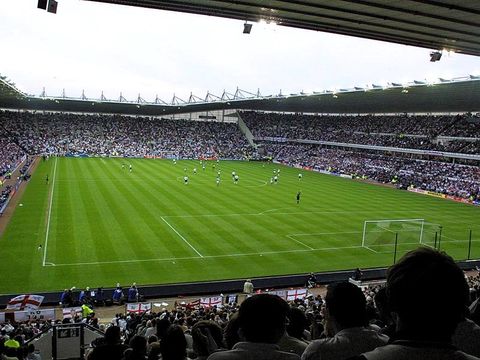
Derby County 3 - 0 Newcastle United.
Sitting amongst fans of the home team, I was the outsider within. Hoping to see Newcastle play a kind of football that would suggest pomp-approaching-glory, things didn't pan out that way. For all of Newcastle's 'clever' play, and their mazily tripping over of the ball, Derby played genius football - simple and effective. Very Clough. The scoreline did flatter Derby, but the honesty of their play, and the commitment of Robbie Savage, saw my non-partisan status become eroded.
 Fumbly phoney photo-work, there. Fair to say, it was cold. The old lady beside me did not share her blanket.
It felt good to be lost in 90 minutes of utter nonsense.
On exiting the stadium - two minutes before the final whistle, I caught a note of burger van fried onions in the chill night air. It was a moment for huddling, for moving briskly, and for missing people.
On leaving Derby, I thought about canal boats and ceramics - traces of an earlier meeting, still occupying my mind.
And so it goes.
Sitting amongst fans of the home team, I was the outsider within. Hoping to see Newcastle play a kind of football that would suggest pomp-approaching-glory, things didn't pan out that way. For all of Newcastle's 'clever' play, and their mazily tripping over of the ball, Derby played genius football - simple and effective. Very Clough. The scoreline did flatter Derby, but the honesty of their play, and the commitment of Robbie Savage, saw my non-partisan status become eroded.
 Fumbly phoney photo-work, there. Fair to say, it was cold. The old lady beside me did not share her blanket.
It felt good to be lost in 90 minutes of utter nonsense.
On exiting the stadium - two minutes before the final whistle, I caught a note of burger van fried onions in the chill night air. It was a moment for huddling, for moving briskly, and for missing people.
On leaving Derby, I thought about canal boats and ceramics - traces of an earlier meeting, still occupying my mind.
And so it goes.
Monday, February 08, 2010
pride
It feels like quite a while, since I was 'myself'.
The context for this is simple and clear. It has become the norm, for me to put others' interests ahead of my own. Or to imagine those others' interests to be my own - which, in part, they are. Fine lines. But I've known, for quite some time, that I have to re-take Shane (what foul foul wording), if I'm to content myself. And so, small steps though they are, I've let Emma know that I'll not be joining her and Alex at a festival in late August - a festival that I'm sure would be good, but one that would also become lost to me, as I'd end up being far more occupied with other peoples' children, rather than the much more interesting adults who'd be on hand. So I've said 'Thanks, but no thanks' to that. Alex' Dad will also be around, along with various other friends and relatives, so there'll be no shortage of bodies.
And I've booked in a trip to London, end of the month, when I'll be getting to the Riverside Studios (Fool for Love) and Soho Theatre (A Life in Three Acts).
Oh, and I've not done anything like enough football over the past few months to keep me spiritually right. So tomorrow evening, I'll be at Pride Park, Derby, for the visit of Newcastle United.
And just in case you're wondering, I haven't gone all dip trip fantasia - 'spiritually right?'. I mean happy. It's simple stuff, that just happens to get waylaid sometimes.
The context for this is simple and clear. It has become the norm, for me to put others' interests ahead of my own. Or to imagine those others' interests to be my own - which, in part, they are. Fine lines. But I've known, for quite some time, that I have to re-take Shane (what foul foul wording), if I'm to content myself. And so, small steps though they are, I've let Emma know that I'll not be joining her and Alex at a festival in late August - a festival that I'm sure would be good, but one that would also become lost to me, as I'd end up being far more occupied with other peoples' children, rather than the much more interesting adults who'd be on hand. So I've said 'Thanks, but no thanks' to that. Alex' Dad will also be around, along with various other friends and relatives, so there'll be no shortage of bodies.
And I've booked in a trip to London, end of the month, when I'll be getting to the Riverside Studios (Fool for Love) and Soho Theatre (A Life in Three Acts).
Oh, and I've not done anything like enough football over the past few months to keep me spiritually right. So tomorrow evening, I'll be at Pride Park, Derby, for the visit of Newcastle United.
And just in case you're wondering, I haven't gone all dip trip fantasia - 'spiritually right?'. I mean happy. It's simple stuff, that just happens to get waylaid sometimes.
Friday, February 05, 2010
boobs
I am being befriended by a DadAtTheEdgeOfThePlayground - only occasionally AtTheEdgeOfThePlayground, truth be told - he works in sales, 'away a lot'. The man's son is Alex' best friend - both boys bright and quirky.
For practical reasons, it's been necessary for DadAtTheEdge' and self to have one another's phone numbers for quite a while. But today, I received a 'comedy text message'. It read:
BREAKING NEWS: John Terry Update - Fabio Capello has released a statement clearing the England captain, 'I don't know what all of the fuss is about... Everyone knows if a full back leaves a hole, it's the job of the centre back to fill it!'
That was it. The comedy text message.
I'm feeling a bit intimidated. Might have to make up some joke about boobs or something, next time I see him. You know, all laddish and that.
For practical reasons, it's been necessary for DadAtTheEdge' and self to have one another's phone numbers for quite a while. But today, I received a 'comedy text message'. It read:
BREAKING NEWS: John Terry Update - Fabio Capello has released a statement clearing the England captain, 'I don't know what all of the fuss is about... Everyone knows if a full back leaves a hole, it's the job of the centre back to fill it!'
That was it. The comedy text message.
I'm feeling a bit intimidated. Might have to make up some joke about boobs or something, next time I see him. You know, all laddish and that.
Subscribe to:
Posts (Atom)